
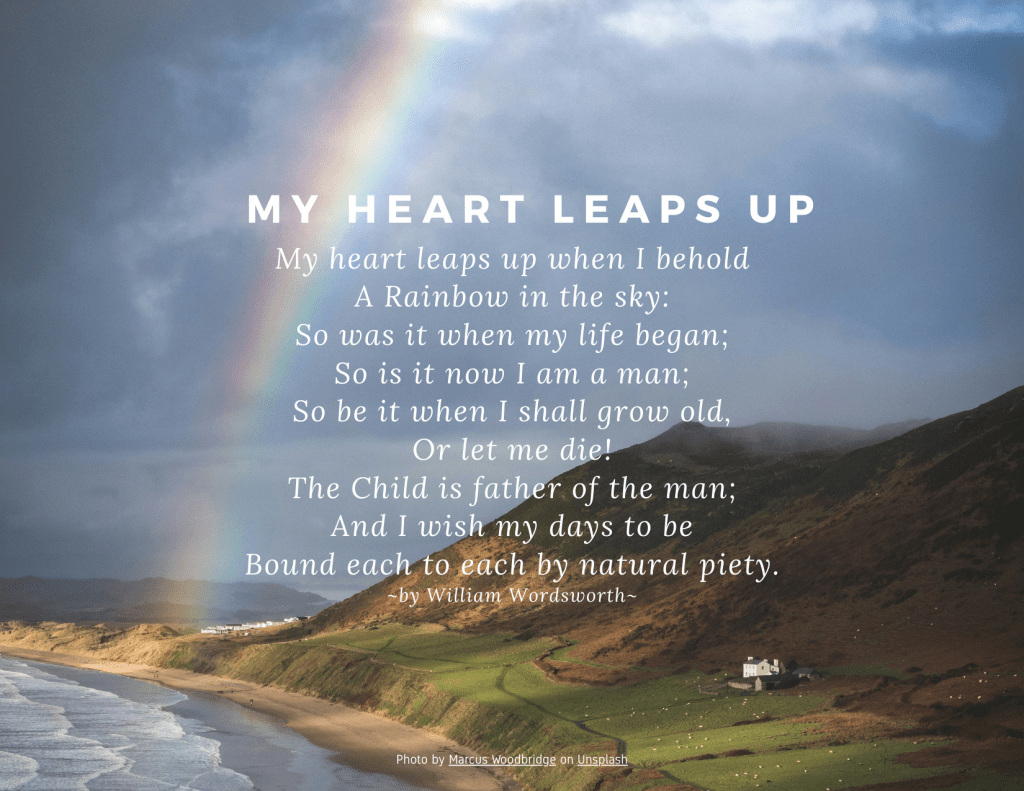
Every time I see a rainbow, I smile and recite this poem because it returns me to a moment when language first felt permanent—when words learned young took root and never quite left. If my memory serves me right, I memorized it in ninth-grade English, at an age when I didn’t yet understand everything it was saying, but felt instinctively that it mattered. The lines stayed with me long after the classroom faded, resurfacing quietly over the years like something patiently waiting to be understood.
What moves me now is how the poem grows alongside the reader. As a teenager, the image of a rainbow was simple wonder—beauty, surprise, joy. As an adult, the lines carry a deeper weight. They speak to continuity, to the hope that who we are at the beginning of life is not lost as we age, but carried forward. “The Child is father of the man” feels less like a paradox now and more like a truth I recognize: that our earliest ways of seeing the world shape who we become, whether we remember them consciously or not.
Reciting the poem reminds me that reverence need not disappear with adulthood. The wish that life be “bound each to each by natural piety” feels like a quiet plea to remain connected—to wonder, to humility, to the small moments that still have the power to move us. Remembering that I once committed these lines to memory reminds me that words can outlast classrooms, exams, and years. They stay with us, ready to speak again when we are finally able to hear them.
Simona A. Brinson
 My Life In Word
Leave a comment