
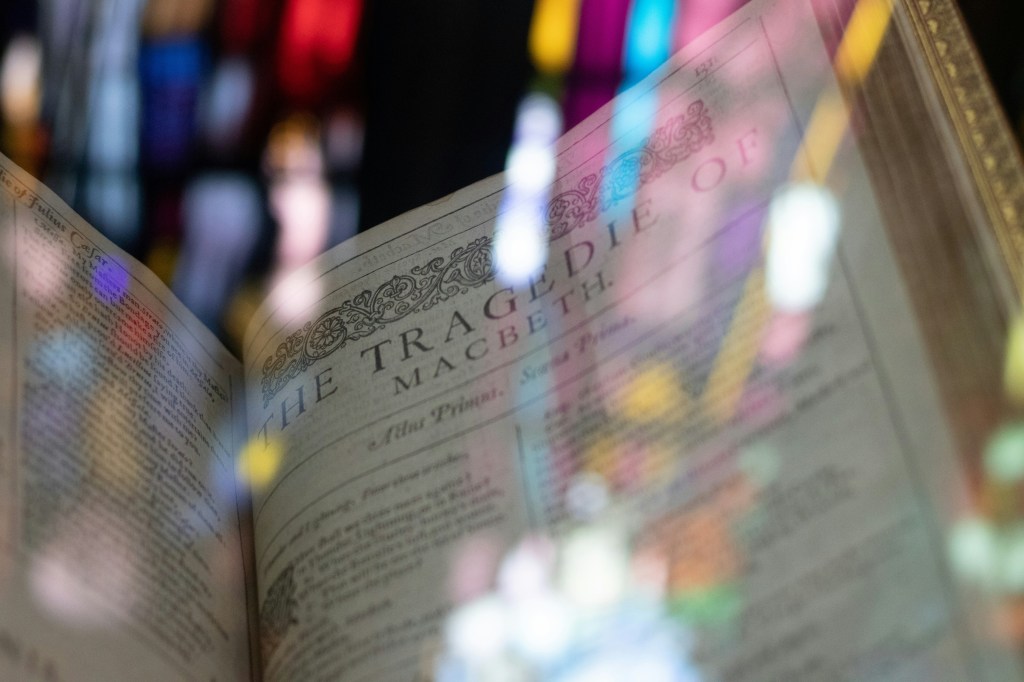
by William Shakespeare
  To-morrow, and to-morrow, and to-morrow,
     Creeps in this petty pace from day to day
     To the last syllable of recorded time,
     And all our yesterdays have lighted fools
     The way to dusty death. Out, out, brief candle!
     Life's but a walking shadow, a poor player
     That struts and frets his hour upon the stage
     And then is heard no more: it is a tale
     Told by an idiot, full of sound and fury,
     Signifying nothing.
Memorizing Macbeth’s “Tomorrow, and tomorrow, and tomorrow” soliloquy was, at the time, just another 9th-grade assignment—lines to repeat until they stuck, rhythms to get right, pauses to remember. But something unexpected happened in the process of committing it to memory: it began to make sense in a way the rest of the play did not. While the larger tragedy once felt distant and difficult to follow, this single passage became clear, almost intimate. Saying the words over and over allowed their meaning to settle in, not just intellectually, but emotionally. The slow, dragging repetition of “tomorrow” started to feel like the weight of time itself, and suddenly Macbeth’s despair didn’t seem abstract—it felt human.
Over time, the soliloquy became more than something I had memorized; it became something I carried. I have found myself returning to it in moments of frustration, especially when dealing with difficult or obnoxious people, when everything feels unnecessarily loud, chaotic, and draining. In those moments, the lines—“it is a tale / Told by an idiot, full of sound and fury, / Signifying nothing”— (Shakespeare 5.5.26–28) resonate with a kind of sharp clarity. They capture that sense of noise without substance, of energy wasted on things that ultimately do not matter. What once was just a requirement for class has become a kind of language for understanding the world. And maybe that is the real value of memorization—it turns words into something lived.
Now, looking back, I realize that this one soliloquy has been my entry point into Macbeth. It has stayed with me longer than any summary or lecture ever could, quietly suggesting that the rest of the play might hold similar depth if I return to it with the same attention. Perhaps it is time to revisit the entire tragedy—not as something to get through, but as something to experience more fully, the way I did with these lines.
Works Cited

Shakespeare, William. Macbeth. Edited by Barbara A. Mowat and Paul Werstine, Folger Shakespeare Library, 2013.
Photo by Matt Riches on Unsplash
 My Life In Word
Leave a comment