
by Shel Silverstein
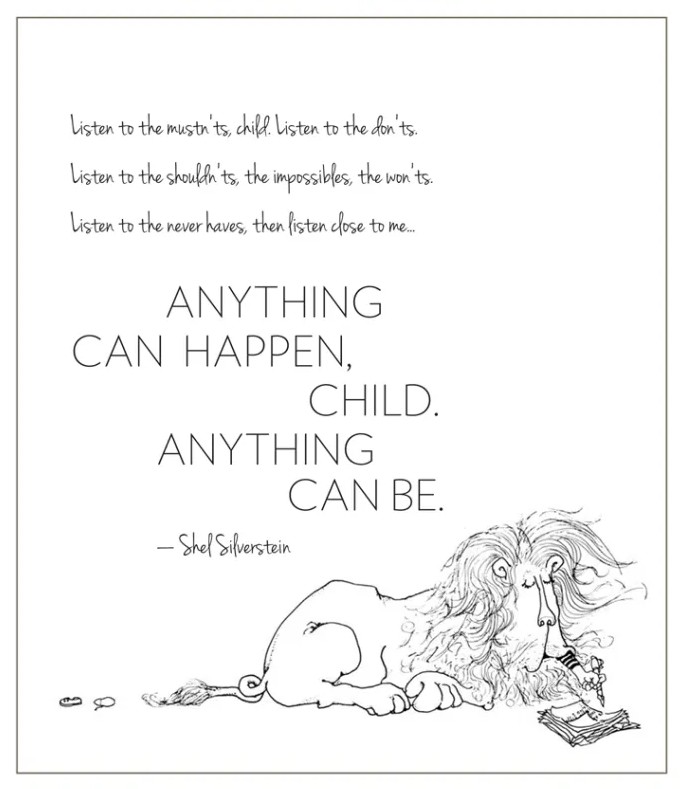
This poem should be framed and hung on the wall of every child because it quietly but powerfully rewrites the limits adults so often place on young minds. Shel Silverstein moves through the language children hear every day—“don’ts,” “shouldn’ts,” “impossibles”—and then deliberately overturns them, replacing restriction with possibility. It’s not just encouragement; it’s permission. In a world that conditions children to measure themselves against rules, outcomes, and expectations, this poem offers a counter-voice that affirms imagination as something valid, necessary, and enduring. Displayed on a wall, it becomes more than decoration—it becomes a daily interruption of doubt, a reminder that creativity and belief are not naive, but essential.
What makes this poem especially meaningful to me is that I didn’t encounter it as a child, but as an adult—around thirty-one—when I bought Where the Sidewalk Ends for myself. And yet, it felt instantly familiar, as if it had been waiting for me all along. I didn’t have to memorize it; it simply stayed, embedding itself into my thinking like a quiet anthem for the daydreamer I’ve always been. That lasting imprint is exactly why it belongs in a child’s environment. If it can reach an adult with that kind of permanence, imagine what it can do for a child who grows up seeing it every day—before the world has a chance to convince them otherwise.
©mylifeinword.com All rights reserved.
 My Life In Word
Leave a comment