
After We Had Finished
By the time I found the field,
winter had already completed its careful revision of the world.

The snow had removed the unnecessary things—
footprints,
distinctions,
directions,
the small evidence that anyone had ever believed another body
could become a home.


I sat because there was nothing left to negotiate.

The ground beneath me was frozen to a depth
no season would confess aloud,
and I wondered whether grief begins this way:
not as an open wound,
but as a landscape surrendering itself molecule by molecule
to a silence so complete
it mistakes itself for truth.

Cold is not an absence.

It is an occupation.

It enters with the courtesy of light through old glass,
asking nothing,
forcing nothing,
only remaining
until every living thing begins to speak
in the language of endurance.

Soon my bones belonged more to the earth
than to the architecture of my own body.

Even breathing became archaeological—
lifting fragments of a life
already disappearing beneath weather,
dusting them gently,
only to discover
they had never been artifacts at all,
only ordinary mornings
made sacred by repetition.

Your name no longer arrived as memory.
It arrived as climate.

As something immense and indifferent,
moving invisibly through me,
altering migration patterns,
emptying forests,
teaching rivers
how to become stone without ever admitting
they had stopped flowing.

I have heard people speak of healing
as though it were a season.

They have never sat long enough
on frozen ground.


They have never watched snow continue falling
onto a world already buried,
understood how suffering possesses
an instinct for excess,
how grief cannot distinguish
between enough
and forever.

Around me,
the trees stood like abandoned cathedrals,
their branches lifting into the white
not in prayer,
but in surrender—
those black veins written across the sky
like a language too ancient
for the mouth to survive speaking.
The silence was unbearable
because it was populated.

Every unlived future wandered there.

The child we never named.

The arguments that dissolved before becoming words.

The ordinary Tuesdays
that will now belong forever
to no one.

Loss is not subtraction.

It is overcrowding.

The soul becomes a house
where every room is occupied
by someone who no longer exists.
I pressed my palm against the ice.
It did not feel cold.

Only absolute.

As though the earth had finally abandoned
the exhausting performance
of becoming.

As though beneath that white skin
the world had chosen permanence
over hope.

I thought then
that perhaps this is why snow is beautiful—
because it disguises extinction
as innocence.

Because it convinces the eye
that untouched and empty
are the same thing.

Because from a distance
even abandonment acquires
the geometry of grace.

When I finally stood,
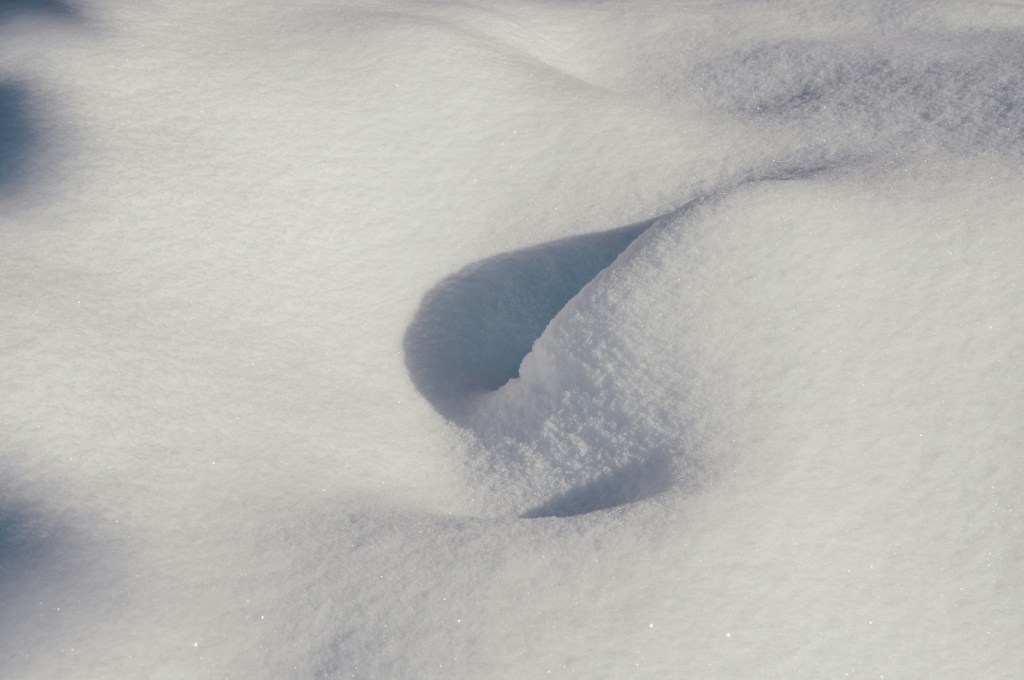
my body left a shallow impression
where it had argued for hours
with the indifferent mathematics of winter.
The snow began filling it immediately.
Not hurriedly.

Not triumphantly.

Simply because the world has always known
how to continue
without witnesses.

I watched the hollow disappear,
watched the earth erase the shape
my grief had borrowed,
until there was nothing left
to suggest I had ever been there at all.
And for one impossible moment,
I envied the snow—
its flawless devotion
to forgetting,
its endless white mouth
closing over every wound
without ever having to learn
the unbearable labor
of forgiveness.

Simona A. Brinson
Photo by Rebecca R on Unsplash
©mylifeinword.com All rights reserved.
 My Life In Word
Leave a comment